


-
Call Us : +86 13728718457
-
Email Us : Lexie@Sharicca.com
Call Us : +86 13728718457
Email Us : Lexie@Sharicca.com

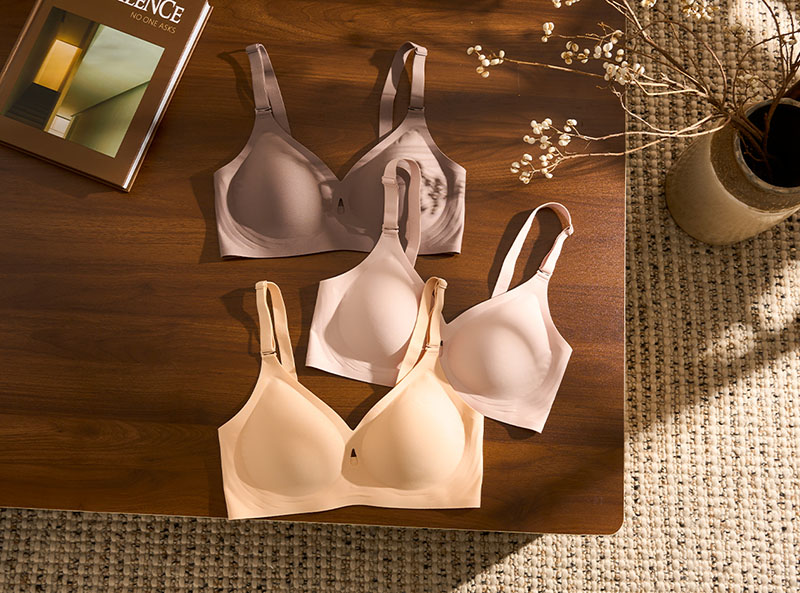
Jelly bras are often introduced as a solution to a long-standing problem in lingerie:
how to achieve support without relying on rigid underwire.
At their best, they offer something genuinely different — soft, adaptive, and stable in a way that traditional seamless bras often struggle to match.
But not all products maintain that performance.
A common pattern appears after a few weeks or months of wear:
the bra still looks intact, but something has changed.
The lift feels weaker. The fit feels less precise. The support is no longer consistent.
From the outside, it’s easy to describe this as “quality issues.”
In reality, what’s happening is more specific:
the system is gradually losing its ability to manage force.
Performance Loss Is Not Sudden — It’s Progressive
Unlike obvious product failures — broken wires, torn seams — jelly bras rarely fail in a visible way.
Instead, performance declines subtly:
This gradual shift is often misunderstood as normal wear.
But in many cases, it reflects how the product was engineered from the beginning.
To understand why, it helps to look at how a jelly bra actually works.
Support Depends on Recovery, Not Just Softness
At the core of a jelly bra is a material designed to deform and return.
When worn, the structure is constantly under load:
A well-engineered system does two things repeatedly:
1.adapts to pressure
2 returns to its original state
This second part — recovery — is where many products begin to break down.
If the material cannot fully recover after deformation, even small losses accumulate over time.
The structure doesn’t collapse immediately, but it slowly loses its ability to respond.
What the wearer experiences is simple:
it still feels soft, but no longer supportive.
When Elastic Behavior Becomes Instability
Not all elastic materials behave the same.
In lower-grade systems, the response to pressure is often linear:
the more force applied, the more the material stretches — without a clear limit or resistance curve.
Initially, this can feel comfortable.
But without controlled resistance, the structure lacks a stable “support point.”
Over time, this leads to:
In contrast, higher-quality systems are designed to respond differently.
They remain flexible at low pressure, but gradually resist as load increases.
This is what allows a bra to feel soft at rest, yet stable in motion.
When that behavior is missing, the product may still look refined — but it cannot maintain performance.
Structure Fatigue: The Hidden Weakness
Even when the material holds up, structure can still weaken over time.
Support depends on how force is shared across the bra. When that balance is uneven, certain areas take on more stress than others. At first, nothing feels different. But gradually, those zones begin to respond less precisely.
The change isn’t sudden. The shape remains, the bra looks intact — yet the support feels less stable, less consistent.Nothing has failed outright.The structure has simply lost its balance.
The Role of Integration in Long-Term Stability
Another key factor in performance over time is how the different elements of the bra are connected.
In some constructions, the support layer is fully integrated into the molded form.
In others, it is attached or layered onto an existing structure.
The difference becomes more apparent with wear.
When layers are not structurally unified, small shifts begin to occur:
These changes are subtle, but cumulative.
Over time, the bra may still appear smooth and intact —
yet the internal alignment that once supported it has changed.
Environmental Stress: Heat, Moisture, and Daily Wear
What happens in daily wear is often very different from controlled testing.
Heat, moisture, and repeated washing quietly change how a bra behaves over time. These shifts are gradual, but they affect how the structure responds — how quickly it recovers, how consistently it supports.
Some products perform well at first, yet begin to feel less stable with regular use. Not because they fail outright, but because they were never designed to maintain the same behavior under changing conditions.
In that sense, the real challenge is not durability alone, but whether the system can hold its performance in the environments it is actually worn in.
Rethinking “Quality” in Jelly Bras
When a jelly bra underperforms, the instinct is often to attribute it to material quality alone.
But performance is rarely determined by a single factor.
It is the result of how multiple elements interact:
If any one of these is overlooked, the system may function initially —
but struggle to maintain that function over time.
A More Useful Question
For brands working with jelly bras, the key question is not:
“Does this product use jelly gel?”
A more useful question is:
“How does this product maintain its structure after repeated use?”
Because long-term performance is not defined by how a bra feels on day one —
but by how consistently it performs over time.
Conclusion
Jelly bras are often positioned as a modern alternative to traditional support systems.
And in many cases, they deliver on that promise.
But their success depends on more than material choice or surface design.
It depends on whether the product has been engineered as a stable, recoverable system — one that can adapt, respond, and return, again and again.
When that system is incomplete, performance doesn’t disappear overnight.
It fades.
And understanding why it fades is the first step toward building products that don’t.
Contact us at below:
📩 Email: Lexie@Sharicca.com
🌐 Website: www.chuangrongapparel.com


